

Many ESL students find the passive voice confusing and frustrating…
So, how can you teach this challenging grammar concept in a way that is both enjoyable and easy to understand? With engaging activities, of course!
Classroom Game I: Changing the Room
Beginners & Pre-intermediate / Young Learners & Teens
This is a tried-and-tested game that is fun and easily adaptable to past and present tenses.
Divide your class into two teams and ask one member of each team to leave the room for two minutes. Ask the remaining students to rearrange some items in the classroom, then invite the two team members back in.
Their task is to identify as many changes as possible, using sentences in the passive voice, e.g. ‘My books were put on another desk’ or ‘These chairs have been moved’. You can award a point for each complete, grammatically correct sentence in the passive voice (or other specified tense). Don’t forget to set a time limit so that as many students as possible can have a turn!
Classroom Game II: Solving the Crime
Beginners & Pre-intermediate / Young Learners & Teens
Are you ready to turn your students into detectives, investigating an exciting case?
Think of a crime that could have been committed in your classroom and create the crime scene. Your students must solve the crime, writing down all the clues they can find in the passive voice, e.g. ‘Muddy footprints were everywhere on the floor, and almost all our chairs were turned over!’.
* Tip: For younger learners, choose a non-frightening crime that could not be realistic, e.g. ‘A fire-breathing dragon tried to enter the classroom and destroy everything!’. You could also tell your students how many clues are hidden in the crime scene.
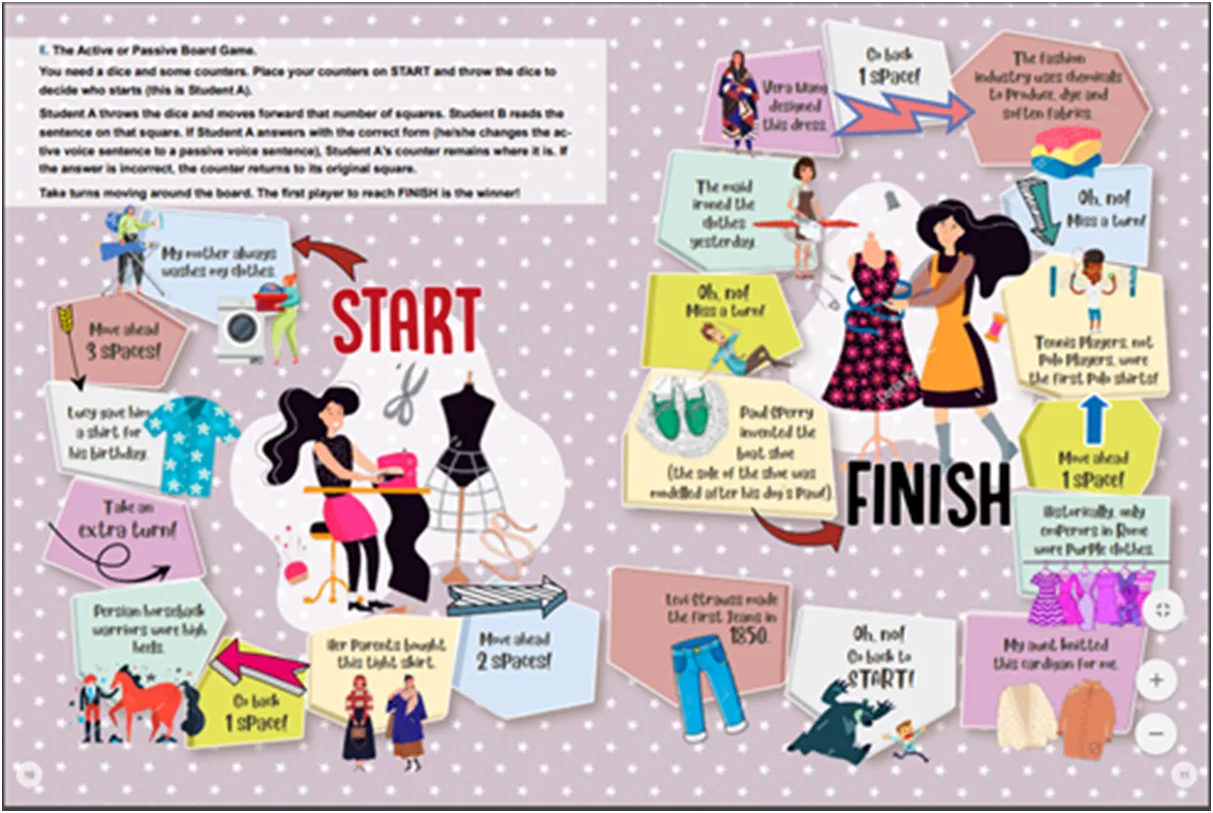
The Passive Voice Board Game
Pre-intermediate / Teens
Yes, the passive voice in English can be tricky. That’s why E-planet is here to help! You just need this amazing board game from our Voices 6 series to make learning and practicing the passive voice enjoyable!
Download it here: The Passive Voice Board Game.